How to document and explain your IBS for the best medical care.

Strawberries not Frankenberries
June 9, 2013
We have some beautiful, red strawberries ripening in our mini strawberry patch that we planted last year. Last year we had none because I knew nothing about jumpers. Yes, last year I learned about suckers on tomato plants, and this year I learned about jumpers on strawberry plants. I planted 3 little plants and they grew to cover a 4’x4′ space – but no fruit grew. I learned that I was supposed to take off the shoots that jumped from the main plant because those jumpers sucked the energy that the plant would have used to grow fruit. This year, there was no more space to jump, so the plants are producing beautiful strawberries. The plants and the soil are organic, so except for some pollen and a little dirt, they can be eaten right after picking (I do tend to wash them though). When you take a bite, they are sweet and melt in your mouth. The seeds that cover the outside (trivia: strawberries are the only fruit with the seeds on the outside!) are so small that they don’t get caught in your teeth. They remind me of the strawberries I ate as a kid. I remember strawberries being sweet and small and not so readily available as they are today. Today’s supermarket strawberries are really big and a little tough on the outside. The seeds are firm and fruit is never as sweet as I remember. Hmmm…
Our food supply has changed in the past few decades. We went from eating locally to eating globally. We no longer have to eat seasonally because our markets ship produce from warm climates to cold climates year round. That’s why I can eat a pineapple on a snowy day in New England. It wasn’t grown here, it was flown here. Food distribution has its benefits; fewer people go hungry when food is shipped to parts of the world where it is not readily available. That said, it also has its disadvantages. Food distribution is big business. The basic economic principle of supply and demand is evident in the produce aisle. If we want to eat tropical fruit in the winter and we don’t live in the tropics, then someone makes money getting it to us. It’s not just the distributors making money; the biological technology companies that are altering the seeds farmers are using to grow our produce and grains are making big bucks and we may be suffering from their gain.
Before there was buzz about GMOs (genetically modified organisms), there was hybridization. There is a difference. Hybridization is what you learned in science class when you studied Mendel and his pea plants. Don’t remember that? How about “survival of the fittest?” Hybridization is the cross-breeding of two seeds with the goal of creating something stronger than the originals. GMOs are different; GMO seeds have had their genes altered by the addition of a gene from another organism, an animal, for example. Testing has been done on strawberries recently (in a lab, and not ones that are in your supermarket…yet), where a gene from an Arctic fish was inserted into the strawberry DNA. The fish had natural antifreeze properties, and the idea was that this gene would make the strawberry more resilient to frost. Good for the strawberry growers – they would lose less of their crops. Good for the biotech companies – more farmers would plant their seeds. But, bad for the people and bad for the environment. For now, let’s focus just on people. Here’s a scenario for you: You have a fish allergy, maybe you don’t even know you have this allergy because you have never had fish from the Arctic waters before. You buy strawberries from the supermarket and use them in a smoothie. You have a reaction. Was it the milk? The soy protein powder you added? The strawberries? You have never had a reaction to any of those foods before. As it stands now, foods that are genetically modified are not labeled (A bill was just passed in CT to label foods containing GMO ingredients, but no labeling is in place at the time of this post). Currently, strawberries are not genetically modified, but with the lack of regulation by our government, it is not far off. Many of our crops are already GMO crops – mainly corn and soybeans. Back to that scenario: Maybe the strawberries didn’t cause the reaction, maybe it was the soy protein powder. The main issue here is that there is no labeling and no testing, so you won’t know if your strawberries have a fish gene in them or if your soy protein has insecticide properties added to it. That can’t sit well in your gut – both figuratively and literally.
Right now, approximately 60% of our processed foods in the US contain GMO ingredients. One way to avoid GMO ingredients is to stay away from processed foods and aim for as many organic fruits and vegetables as you can afford. Organic farmers do not use GMO seeds. There are also products on the market that are labeled as non-GMO, so choose those over ones without a label. You could also turn your yard into a farm and take yourself “off the grid,” but that may not be the most convenient solution. My advice: contact your government representatives and ask them to support GMO labeling. We are doing it here in CT, so if this little state can do it, others can too.
In the meantime, I plan on eating my strawberries while they last, and find comfort in the fact that they were grown from fish-free strawberry seeds.
xo
B
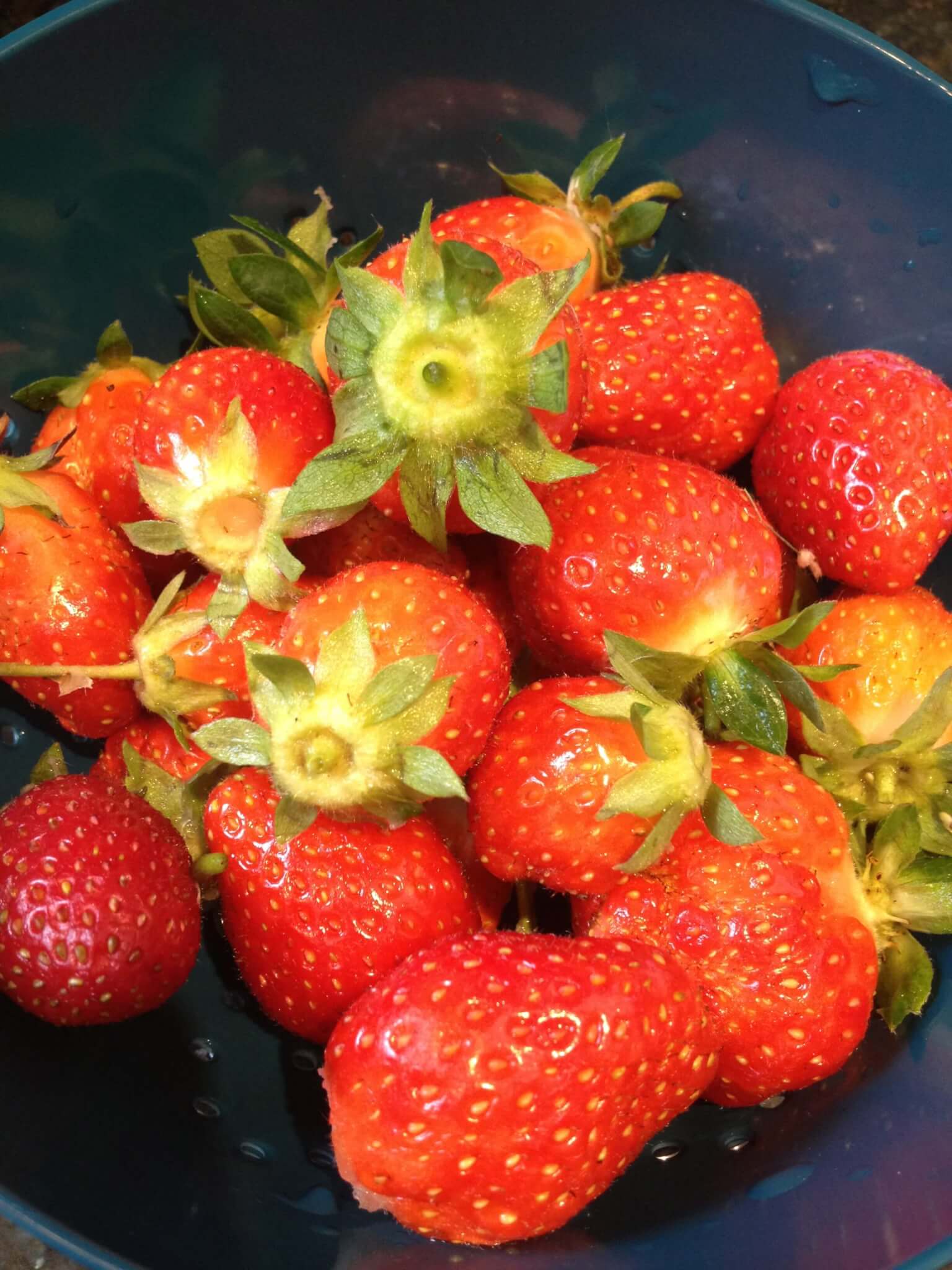
Strawberries from my patch.

Beth Rosen
Eating Attitudes™ & Gut Expert
Beth Rosen, MS, RD, CDN is a Registered Dietitian and owner of Beth Rosen Nutrition. She practices a non-diet philosophy and is a Health at Every Size" practitioner. Her goal is to end the pain of diet culture, one person at a time. Beth's techniques and programs empower chronic dieters, and those who consider themselves emotional and /or stress eaters, to ditch the vicious cycle of dieting, eat fearlessly by removing Food and diet rules, and mend their relationship with food and their bodies. Beth's works face-to-face with clients in Southbury, CT, and virtually with clients, worldwide.