How to document and explain your IBS for the best medical care.
Intuitive Eating: An Introduction to How to Quit Dieting For Good
May 13, 2024
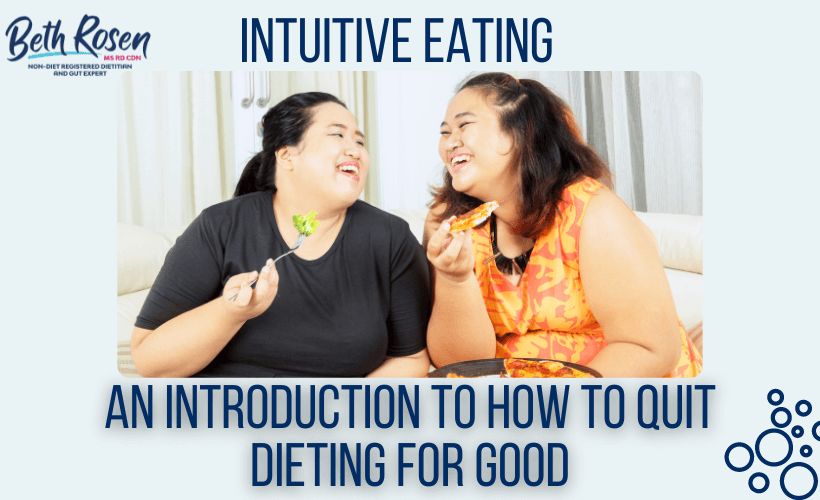
In a world dominated by diets, calorie counting, and weight loss regimes, a refreshing paradigm shift has existed but is not well-known among dieters—Intuitive Eating. It’s not another fleeting weight loss trend but a profound philosophy that reconnects individuals with their innate wisdom regarding food and body.
At its core, Intuitive Eating is about listening to your body’s signals and honoring its natural cues for hunger, fullness, and satisfaction. Developed by dietitians Evelyn Tribole and Elyse Resch, this approach emphasizes rejecting the diet mentality and cultivating a positive relationship with food, free from guilt or restriction. It is the antithesis of controlling your body through dieting; it allows your body to exist in its natural form while being cared for based on its intrinsic needs.
Before we explore the principles of Intuitive Eating, it’s crucial to understand the detrimental effects of dieting. Research has consistently shown that diets not only fail the majority of people in achieving long-term weight loss but also contribute to a myriad of negative outcomes.
First and foremost, dieting often exacerbates weight stigma—a pervasive societal bias that equates thinness with worthiness and moral virtue. This stigma can lead to feelings of shame, guilt, and low self-esteem, further perpetuating the cycle of disordered eating behaviors and poor body image.
Moreover, the pursuit of weight loss through restrictive dieting has been linked to an increased risk of developing eating disorders such as anorexia nervosa, bulimia nervosa, and binge eating disorder. These serious mental health conditions can have profound and long-lasting consequences on both physical and psychological well-being.
In addition to its impact on mental health, dieting can also take a toll on the cardiovascular system. Rapid weight loss and yo-yo dieting have been associated with an increased risk of heart disease, hypertension, and other cardiovascular complications. Ironically, dieting is often prescribed to avoid and manage cardiovascular diseases when it is one of the risk factors for their increased risk.
Now, let’s explore the principles of Intuitive Eating and why it offers a compassionate and superior alternative to traditional dieting:
1. Reject the Diet Mentality: Discard the notion of quick-fix diets and the false promises of permanent weight loss. Recognize the damaging effects of diet culture and the constant cycle of failure it perpetuates. Embrace the freedom to explore Intuitive Eating without the lingering hope of finding a better diet.
Example of Practicing Principle 1: Remove diet books and articles promoting restrictive eating from your surroundings. Unfollow social media accounts that promote unrealistic body standards. Surround yourself with positive influences supporting your journey towards Intuitive Eating.
2. Honor Your Hunger: Respect your body’s signals for hunger and nourishment. Understand that ignoring hunger cues can lead to overeating later on. Prioritize fueling your body adequately to rebuild trust in yourself and food.
Example of Practicing Principle 2: Begin your day with a balanced breakfast to provide energy and satisfaction until your next meal. Tune into your body’s hunger signals throughout the day, nourishing yourself with regular meals and snacks without judgment.
3. Make Peace with Food: End the internal struggle with food by granting yourself unconditional permission to eat. Release the notion of “good” and “bad” foods, avoiding feelings of deprivation that can lead to bingeing and guilt. Remind yourself that no food is morally superior to another.
Example of Practicing Principle 3: Be curious about your food rules and ask yourself where you learned them, if they are true, and if they align with your values about food and your body. Allow yourself to remove restriction and make peace with all foods.
4. Challenge the Food Police: Silence the inner critic that dictates worth based on food choices and negative thoughts and beliefs surrounding food and body image. Dismiss the unrealistic rules imposed by diet culture.
Example of Practicing Principle 4: Challenge negative thoughts about food and body image, recognizing their origins in diet culture. Focus on how foods make you feel physically and emotionally rather than labeling them as “good” or “bad.”
5. Discover the Satisfaction Factor: Embrace the pleasure and satisfaction of eating. Create an inviting environment for meals, savoring each bite to determine satiety. Enjoyment should be a part of eating so if you don’t like what you are eating, and you are able to do so, choose something else.
Example of Practicing Principle 5: Take time to enjoy the flavors, textures, and aromas of food. Create a peaceful eating environment free from distractions, allowing for greater satisfaction with smaller portions. Include fun foods without guilt if you like them.
6. Feel Your Fullness: Listen to your body’s signals of fullness and satisfaction. Pause during meals to assess hunger levels and physical sensations.
Example of Practicing Principle 6: Check in with your body throughout meals to determine hunger and fullness levels. Pause halfway through eating to assess satisfaction and decide if you’re still hungry.
7. Cope with Your Emotions with Kindness: Recognize that food cannot solve emotional issues permanently. There is nothing wrong with emotional eating, but finding other coping skills that help you manage your feelings for the long-term. Be compassionate with yourself if you do choose food.
Example of Practicing Principle 7: Engage in activities that provide comfort and support during times of emotional distress. Create a “toolbox” of coping skills which may include connecting with a friend, reading or taking a walk, and having a good cry and then a nap.
8. Respect Your Body: Accept and appreciate your body’s unique shape and size. Reject unrealistic beauty standards and embrace self-respect and dignity.
Example of Practicing Principle 8: Acknowledge your body for its strength and resilience in getting you to this point in your life. Treat your body with kindness and respect, focusing on nourishment and well-being rather than appearance.
9. Movement—Feel the Difference: Shift focus from exercise as a means of burning calories and attaining thinness to an opportunity to connect with your body and enhance well-being.
Example of Practicing Principle 9: Engage in physical activities that bring joy and vitality, focusing on how movement makes you feel rather than calorie expenditure.
10. Honor Your Health—Gentle Nutrition: Make food choices that prioritize health and taste while allowing for flexibility and enjoyment. Understand that consistency over time is key to overall well-being.
Example of Practicing Principle 10: Choose foods that nourish your body and satisfy your taste buds. Focus on progress rather than perfection in your dietary choices when managing diseases or while in eating disorder recovery.
Intuitive Eating offers a sustainable approach to nourishment that prioritizes health and well-being over arbitrary weight goals. By rejecting the diet mentality and embracing these 10 principles you can liberate yourself from the harmful cycle of dieting and embark on a journey of self-discovery, acceptance, and empowerment. So, let go of the diet culture’s rules that have kept you in shackles, learn to trust your body’s wisdom, and embrace the freedom of Intuitive Eating.
Need help moving away from the diet cycle? Reach out to me and let’s get you started!

Beth Rosen
Eating Attitudes™ & Gut Expert
Beth Rosen, MS, RD, CDN is a Registered Dietitian and owner of Beth Rosen Nutrition. She practices a non-diet philosophy and is a Health at Every Size" practitioner. Her goal is to end the pain of diet culture, one person at a time. Beth's techniques and programs empower chronic dieters, and those who consider themselves emotional and /or stress eaters, to ditch the vicious cycle of dieting, eat fearlessly by removing Food and diet rules, and mend their relationship with food and their bodies. Beth's works face-to-face with clients in Southbury, CT, and virtually with clients, worldwide.