How to document and explain your IBS for the best medical care.
Actionable Steps to Reduce Weight Stigma and Create an Inclusive Society
June 11, 2019
Are you ready to make a change? Let’s rid our society of weight stigma – the cause of so much harm.
As part of my professional development as a Registered Dietitian, and to expand my knowledge and clinical expertise on the topics of body image and self-esteem, I attended the National Eating Disorder Information Centre’s (NEDIC) conference in Toronto, Canada.
I recently had the opportunity to attend The National Eating Disorder Information Centre’s (NEDIC) biennial body image and self-esteem conference entitled, “Radical Unlearning” in Toronto, Canada. While I initially registered to attend because of the incredible activists that would be attending and speaking, including Dianne Bondy, author of Yoga For All, Lucy Aphramor, co-author of Body Respect, and the inimitable Sonya Renee Taylor, Founder, Radical Executive Officer of The Body is Not An Apology, and the author of the book by the same name, I found so much inspiration from the speakers I knew nothing about.
When I attend conferences, I take copious notes so that I can attempt to remember some of the points made at each session… because, by the end of a conference, my brain is on overload!
The title of this conference held true; there was definitely radical unlearning taking place. I collected a number of fact gems from each of the sessions about disordered eating, eating disorders, body image, self-esteem, and fatphobia and the role that the fashion, diet, fitness, beauty, and medical establishments play in the cycle of trauma that perpetuates these issues.
I could go on for pages sharing the details of every session, but in the interest of space and your time, I have whittled these fact gems down to the following items for your consideration.
Fashion and Bodies
We are all aware of the fashion industry’s narrow view of body ideals, but did you know that 40% of the clothing shown at Fashion Week only goes up to a size 14? With the average size of North American women now being 16-18, much of what is shown there is not accessible to a large percentage of women. The reason is this: Body anxiety fuel sales. There are status and privileges to be had when what you wear comes from any store of your choosing.
Women who wear “plus sizes” (I put that in quotations because plus size isn’t actually above the average; it is average) don’t have the same opportunities to shop at the local mall. True, some stores have sections for them, some stores cater to the smaller women in that category, but women in sizes 26 and above have very little available to them, even online.
Dr. Ben Barry, Ph.D. from Ryerson University in Toronto shared that this is systemic in fashion and the cycle is vicious. The players not only include the designers, but they also include the modeling agencies, the magazines, and the fashion schools who use past fashion to influence future fashion.
So what can we do? If you are in a body that’s a size 14 and under, you can make the choice to shop from stores and brands that are size-inclusive. While it may not impact you to shop at a store that only carries sizes 0-14, the message to that company will be heard if more of us who wear those sizes act as allies for people in larger bodies and spend our money on size-inclusive brands’ clothing.
Sonya Renee Taylor and Bodies
This woman is incredible! If you have not read her book, The Body Is Not An Apology: The Power of Radical Self-Love put it on your to-read list. The basis of her message is that helping people heal from eating disorders isn’t the only work to be done; we need to dismantle racism, ableism, fatphobia, and the like to make body diversity something we cherish and honor. Our current system of body privilege is stopping us from doing this and it triggers eating disorders. Some of her action steps included the following:
- Interrogate your bias. We speak fatphobia, ageism, healthism, etc because that is the language of our society. No one is exempt from these thoughts and feelings, but naming them and being aware of them can help us to change our viewpoints.
- Place moral judgment on those who refuse to learn a new language. We can’t be allies or upstanders if we don’t confront those who perpetuate biases.
- Don’t be nice. Be Brave. Be fear-facing and determine where this lives in you and unapologetically root them out.
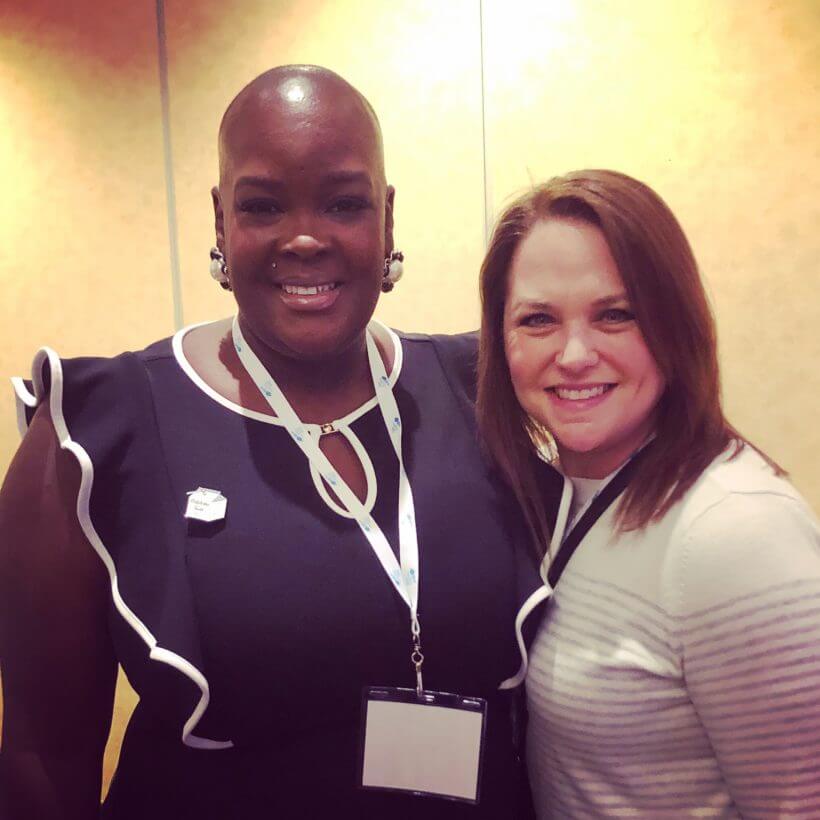
Sonya Renee Taylor and me!
Weight Bias and Bodies
Gerry Kasten, MSc, RD led the session on weight bias amongst health practitioners. Here are some of the fact nuggets he shared:
- Diets work, they just don’t keep working. 53% of people regain the lost weight within 2 years, and 78% regain the weight within 5 years (I’ve seen higher rates in data showing a range from 88%-95% of people who regain lost weight from dieting).
- The most common outcome of weight loss is weight gain.
- Knowing someone’s weight doesn’t/shouldn’t change the intervention we implement with our patients/clients. What we prescribe for thin people should also be prescribed for fat people.
- Healthy behaviors should be used as evaluators instead of weight and BMI. We have evidence that behaviors make a difference regardless of weight changes and we have evidence that BMI is an inaccurate and ineffective measure of health.
- When we tell people to lose weight, we are doing a disservice because it is ineffective, and causes harm in the form of weight stigma.
- Weight stigma can lead to participation in disordered eating behaviors and the lack of participation in exercise. This will lead to higher rates of morbidity and mortality.
So what can we do? This is what was suggested:
- End poverty, loneliness, and social isolation as these factors impact our morbidity and mortality at the same rate that cigarette smoking does.
- Acknowledge trauma experienced throughout our clients’ lives. Trauma can disrupt the development of the brain in childhood and influence health in adulthood.
- Talk about internalized weight stigma and let them know that all bodies have value, even the parts they don’t like.
I hope you will let these ideas ruminate and grow within you and consider how we might live in our bodies if weight stigma no longer existed. There is a lot of hard work to be done to get to that point and it may seem impossible, but the more of us that do just one thing differently to allow for body diversity and acceptance in our society, we might just see that change happen.
If you are looking to make peace with food and your body from a weight-inclusive lens, check out my Food and Body Freedom online course.

Beth Rosen
Eating Attitudes™ & Gut Expert
Beth Rosen, MS, RD, CDN is a Registered Dietitian and owner of Beth Rosen Nutrition. She practices a non-diet philosophy and is a Health at Every Size" practitioner. Her goal is to end the pain of diet culture, one person at a time. Beth's techniques and programs empower chronic dieters, and those who consider themselves emotional and /or stress eaters, to ditch the vicious cycle of dieting, eat fearlessly by removing Food and diet rules, and mend their relationship with food and their bodies. Beth's works face-to-face with clients in Southbury, CT, and virtually with clients, worldwide.