How to document and explain your IBS for the best medical care.
4 Quick Tips to Ease Anxiety With Irritable Bowel Syndrome
September 9, 2019
Your gut and brain are connected. Sometimes, your symptoms are not caused by what you eat.
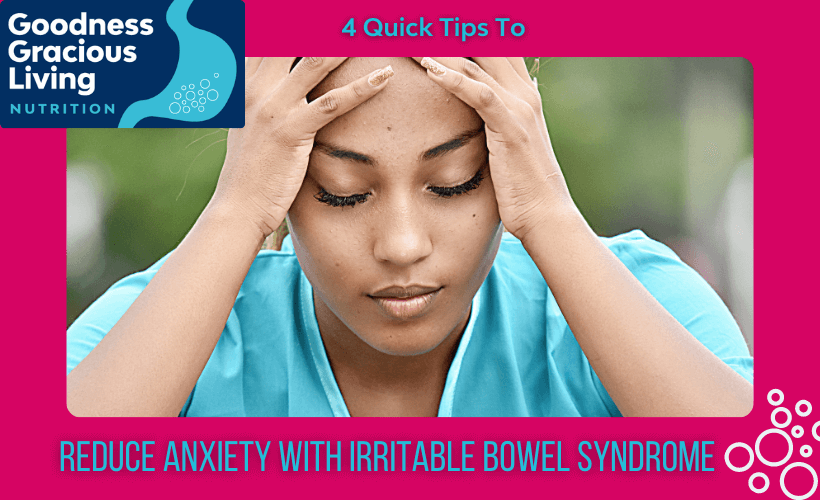
Irritable Bowel Syndrome (IBS) is a digestive disorder, but it also impacts mental, physical, and emotional health.
Epicured, a Low-FODMAP and Gluten-Free meal delivery company offering fully cooked meals and snacks asked me to be one of their Epicurators.
When we were discussing some tips I might share, the folks at Epicured loved that I was a non-diet Dietitian and wanted my perspective on how I incorporate the Health At Every Size® paradigm into my work with clients with digestive disorders.
I’ve helped hundreds of clients with digestive disorders and a common co-occurrence that I’ve seen is anxiety; anxiety associated with eating and impending pain and urgency to find a bathroom, anxiety from past diet rules that conflict with the Low-FODMAP diet, and anxiety associated with the unexpected and irregular appearance of their bloated bellies.
Much of this anxiety stems from past history with diet culture, but when we move away from diet culture and its conflicting rules, impending shame, and eventual body distrust and dissatisfaction, we can reduce the anxiety and begin to heal our relationship with food and our bodies.
This approach to health can be applied to not only moving away from chronic dieting and intentional weight loss attempts but also to managing chronic health issues like Irritable Bowel Syndrome, Diabetes, and Hypertension, where our eating pattern and food choices may help to manage our health.
For my time as Epicurator, I put together four quick tips to help ease anxiety with Irritable Bowel Syndrome:
1. Don’t Believe the Diet Hype!
There are so many diet trends in our society and some of them have us avoiding certain macronutrients like carbohydrates. Diet rules can send us mixed signals (and false information!) about food and lead to food confusion and avoidance. The truth is that some carbohydrates can minimize symptoms associated with digestive disorders. Before you remove foods from your diet, remember that what works for one person may not work for you.
As an Epicurator, I busted the myth about carbohydrates and shared the important role they serve in our gut health. You can watch the video here.
2. Ditch Food Labeling!
Especially when following the Low-FODMAP diet! Placing the “bad” label on foods leads to feelings of guilt and shame when we eat them. When high-FODMAP foods are labeled as “bad,” it creates an additional challenge during the reintroduction phase, when these foods are added back to the diet to pinpoint your personal food triggers. Instead, you can refer to low-FODMAP foods as “safe during the elimination phase” and high-FODMAP foods as “unsafe during the elimination phase” which will remind you that this categorization is only temporary.
3. Know Your Worth!
You are worthy of feeling good in your body and trusting your gut again. The majority of the people I see in my practice are women and many of them have assumed the caretaker role in their lives and put their own needs on the back burner. Make yourself a priority and get help quickly by putting all of your digestive health history in one document (ie my free download, Own Your IBS) that you can share with your healthcare team. It is possible to live symptom-free and feel good in the skin you are in!
4. Seek Out Support!
Creating a healthcare team to solve your gut health issues does not end once you find a Gastroenterologist and a GI Registered Dietitian. There are mental health professionals that can help you to manage your anxiety through Cognitive Behavioral Therapy (CBT) Gut-Directed Hypnotherapy, and relaxation techniques. Seek out the support of an expert in these tools or a mental health professional who specializes in digestive health.
If you want to learn more about the low-FODMAP diet to improve your gut health, check out my online course, Get Your Gut In Sync, which will not only help you determine your food triggers but also support you in managing stress and offer a number of non-diet solutions to manage your IBS symptoms and feel good in your body again.

Beth Rosen
Eating Attitudes™ & Gut Expert
Beth Rosen, MS, RD, CDN is a Registered Dietitian and owner of Beth Rosen Nutrition. She practices a non-diet philosophy and is a Health at Every Size" practitioner. Her goal is to end the pain of diet culture, one person at a time. Beth's techniques and programs empower chronic dieters, and those who consider themselves emotional and /or stress eaters, to ditch the vicious cycle of dieting, eat fearlessly by removing Food and diet rules, and mend their relationship with food and their bodies. Beth's works face-to-face with clients in Southbury, CT, and virtually with clients, worldwide.